|
TAKE ADVANTAGE OF OUR EXTRA-SPECIAL PRICES ON OUR
NEW PROMOTION - KEEP WATCHING THIS SPACE FOR OUR
FAVOURABLE PRICE OFFERS
---------------------------------------------------------------------
ANCIENT WORLD COINS
BYZANTINE EMPIRE
The fall of Roman power in the West left the gold currency of the Byzantine Empire undisturbed; it was to become the most dominant single influence in European coinage for 1,000 years.
EMPEROR JUSTIN 1
HISTORIC COINAGE IN YOUR HANDS
NOW AVAILABLE - CALL TO CONFIRM
AD 518 - 527
A V TREMISSIS
COINAGE OF THE
BYZANTINE EMPIRE
USED IN CONSTANTINOPLE
The tremissis or tremissis was a small solid coin of Late Antiquity. Its name, meaning "a third of a unit", formed by analogy with semissis (half of a unit), indicating its value relative to the solidus.
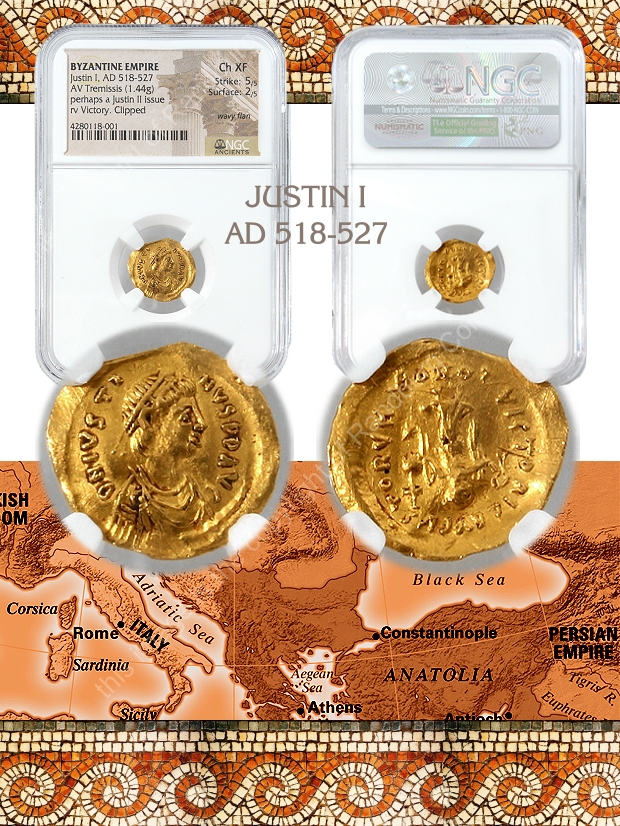
- Details: Gold 1.44grams
Justin I, (born c. 450, Bederiana, Macedonia Salurtaris—died Aug. 1, 527), Byzantine emperor (from 518) who was a champion of Christian orthodoxy; he was the uncle and predecessor of the great emperor Justinian.
Throughout his reign, Justin, though by no means the nonentity often supposed, had the help of his gifted nephew Justinian I. Justinian was formally recognized as his co-emperor only a few months before Justin’s I death.
THE COIN ABOVE IS NOW AVAILABLE AT AN
EXTRA SPECIAL PRICE
IN CHOICE CONDITION
AS PER THE IMAGE ABOVE
R 9 500
Superb Gold numismatic coin
Don't miss this price opportunity
offer based on a first come first served basis - contact us on +27 (0)11 789 2233
---------------------------------------------------------------------
ANCIENT WORLD COINS
BYZANTINE EMPIRE
The fall of Roman power in the West left the gold currency of the Byzantine Empire undisturbed; it was to become the most dominant single influence in European coinage for 1,000 years.
EMPEROR JUSTINIAN 1
HISTORIC COINAGE IN YOUR HANDS
NOW AVAILABLE - CALL TO CONFIRM
AD 527 - 565
A V SOLIDUS
COINAGE OF THE
BYZANTINE EMPIRE
USED IN CONSTANTINOPLE
Shortly after being acclaimed by the army as Augustus in A.D. 306, Constantine the Great (A.D. 306-337) reformed the Roman coinage. He replaced the fundamental gold denomination of the Roman period, the aureus, with a new and slightly lighter gold coin, the solidus. Although the introduction of the solidus did not result immediately in coin designs significantly different from those of the second and third centuries, over the course of the following two centuries the solidus gradually evolved into a coinage with an appearance and identity of its own.
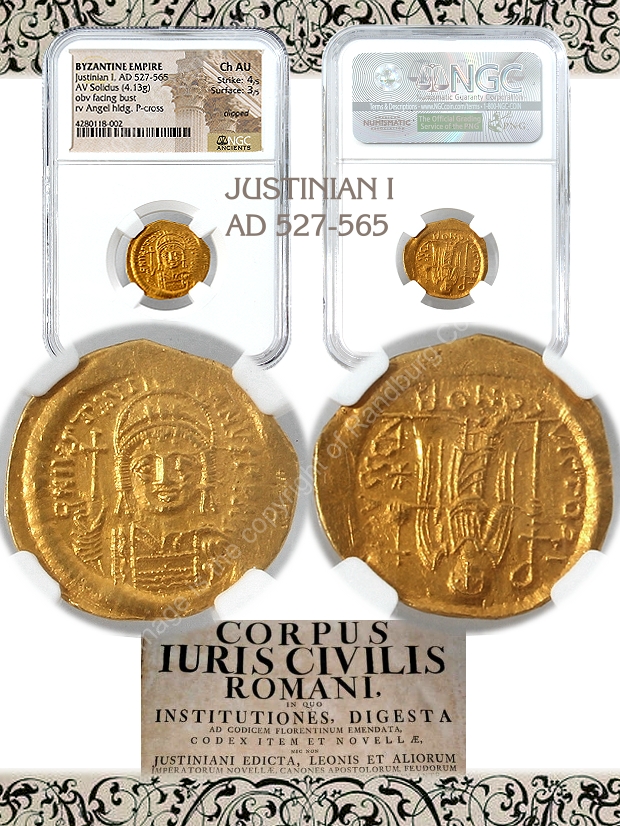
Details: Gold 4.13grams
Justinian I, Latin in full Flavius Justinianus, original name Petrus Sabbatius (born 483, Tauresium, Dardania [probably near modern Skopje, Macedonia]—died November 14, 565, Constantinople [now Istanbul, Turkey]), Byzantine emperor (527–565), noted for his administrative reorganization of the imperial government and for his sponsorship of a codification of laws known as the Codex Justinianus (534).
THE COIN ABOVE IS NOW AVAILABLE AT AN
EXTRA SPECIAL PRICE
IN CHOICE CONDITION
AS PER THE IMAGE ABOVE
R 12 500
Superb Gold numismatic coin
Don't miss this price opportunity
offer based on a first come first served basis - contact us on +27 (0)11 789 2233
----------------------------------
Description:
TRADE COINAGE
GOLD SOLIDUS AND TREMISSIS
The start of what is viewed as the Byzantine currency by numismatics began with the monetary reform of Anastasius in 498, who reformed the late Roman Empire coinage system which consisted of the gold solidus, gold tremis and the bronze nummi.
The gold solidus or nomisma remained a standard of international commerce until the 11th century when it began to be debased under successive emperors beginning in the 1030s under the Emperor Romanos Argyros (1028–1034). Until that time, the fineness of the gold remained consistent at about 0.955–0.980.
The full weight solidus was struck at 72 to the Roman pound. The Byzantine coinage had a prestige that lasted until near the end of the Empire. European rulers, once they again started issuing their own coins, tended to follow a simplified version of Byzantine patterns, with full face ruler portraits on the obverse.
---------------------------------------------------------------------
TO RESERVE
Call Randburg Coin Now (011) 789-2233 or (011) 789 -2234
Or email us by clicking on > This email address is being protected from spambots. You need JavaScript enabled to view it.
Offer expires - Friday18th August 2017 - and/or subject to availability.
We will add you to our list of clients who already receive these specials and promotions on email.
If at anytime you would like to opt out please notify us.
E & OE - Subject to our terms and conditions.
KINDLY NOTE: Payment methods we accept on this promotion are - bank transfer or cash on collection.
|