|
this composite image is the copyright of Randburg Coin only
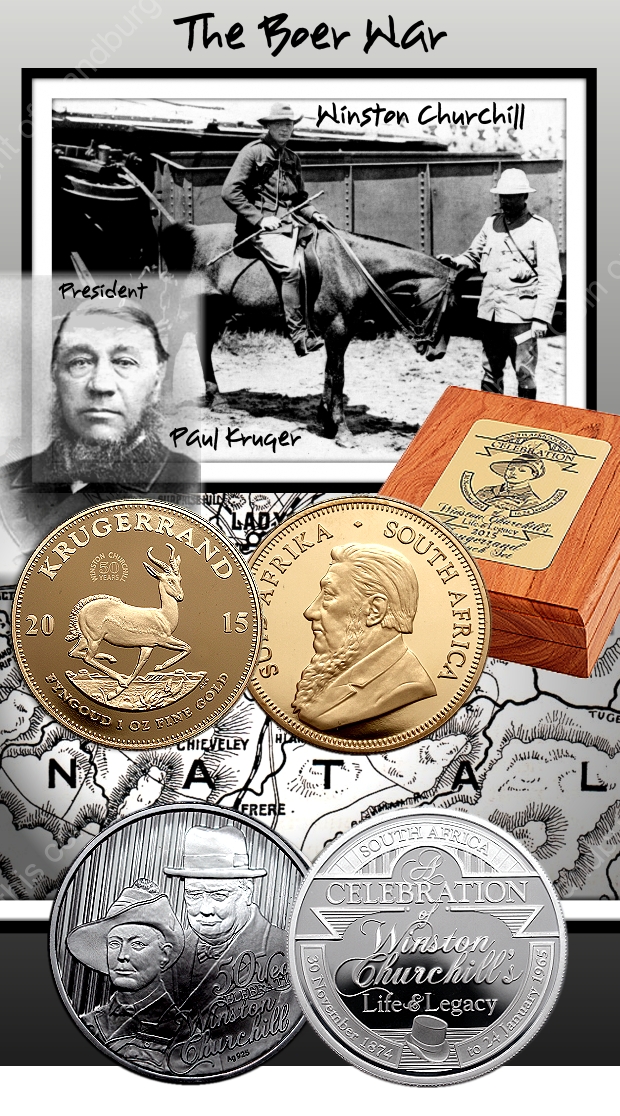
Winston Churchill by the wrecked railway trucks of the Armoured Train at Chieveley on 15th November 1899
Winston Churchill was part of a scouting expedition on an armoured train when it was attacked by the Boers.
A CHOICE GOLD SET
BE ONE OF THE FEW TO OWN
THIS TRULY MAGNIFICENT COMMEMORATIVE SET
OUR PROMOTION PRICE
R 95 000 ONLY
GET THIS ICONIC LAUNCH SET
NOW SELLING AT AN ADVANTAGEOUS PRICE OPPORTUNITY
Details
1 oz Gold Krugerrand : 916 Au
1oz Sterling Silver Medallion : 925 Ag
Mintage - Limited Edition Worldwide of Set : 284 only
Certificated set
Info
War: The Boer War.
Date: 15th December 1899
Place : Colenso on the Tugela River in Northern Natal, South Africa
Combatants: British against the Boers.
Generals: General Sir Redvers Buller against General Botha.
Size of the armies: 16,000 British against 12,000 Boers.
Arms and equipment at the Battle of Colenso: The Boer War was a serious jolt for the British Army. At the outbreak of the war British tactics were appropriate for the use of single shot firearms, fired in volleys controlled by company and battalion officers, the troops fighting in close order. The need for tight formations had been emphasised time and again in colonial fighting.
Churchill's heroics during the ambush led to speculation that he would receive the Victoria Cross, although this never happened.
He was taken to a prison camp in Pretoria but a month later he made his escape and travelled 300 miles to safety.
He became a national hero, but it was not enough for Churchill who then joined the army and helped relieve the British at the Siege of Ladysmith and then take Pretoria . Source: Mail Online
On 15th November 1899 the Armoured Train left Estcourt with a company of Royal Dublin Fusiliers a half-company of Durban Light Infantry and a 7 pounder muzzle loading gun manned by a naval gun crew, all commanded by Captain Haldane. Also on board was Mr Winston Churchill, the war correspondent of the Morning Post.
Travelling north the train passed Chieveley and then encountered Boers in strength on a hill. One of the advantages of the railway was the ability to use the telegraph laid along the line. The presence of Boers was reported back to Estcourt and the train ordered back. Two miles short of Frere the train encountered a force of Boers with two field guns and a Maxim pom-pom gun. The Boers opened fire and the driver put on full speed to escape, but the Boers had placed a large rock on the line which the train hit, derailing several trucks.
Under heavy fire from the Boers Haldane and Churchill supervised the operation of moving the damaged trucks off the line so that the engine was able to pass the obstacle, but without any of the trucks. Churchill set off on the engine with the wounded. After reaching Frere Churchill returned on foot to the scene, arriving in time to be part of the surrender of the remaining eighty soldiers. Source: British Battles.com
When Churchill escaped from the P O W camp, a wanted poster was issued, offering £25 for the young war correspondent’s recapture.
The Boer authorities distributed a description of him, noting that he could not speak a word of Dutch. Despite this, he made it to safety.
Boer commander PJ Joubert, who had imprisoned Churchill two months earlier, said: ‘He is just 'n klein koerant-skrywertjie’ - ‘he’s just a little newspaper man’.
Soon after gaining his freedom, Churchill joined the South African Light Horse Cavalry, an irregular cavalry unit which fought his former captors.
For the next few months, he stayed on in South Africa as a soldier/correspondent, thrilling readers with his reportage and slow march to victory. Source: Mail Online
|