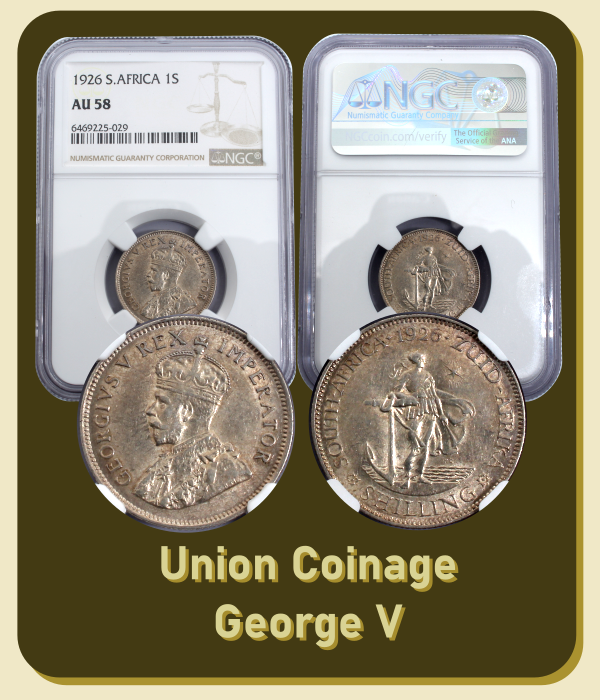
1926 Silver 1 Shillling Union of South Africa Graded AU58

Banner logo Randburg Coin Pty Ltd 800x185  

Ref: 2026 01 23

This offer expires on the 30th January 2026

FANTASTIC FRIDAY OFFERS

KEEP WATCHING THIS SPACE FOR AWESOME OFFERS

Dear Collectors

A CHOICE NUMISMATIC OFFER

*

ONE HUNDRED YEAR OLD UNION COIN

!!! A MUST HAVE !!!

1926

ALMOST

UNCIRCULATED

SILVER COIN

OF THE

UNION PERIOD

OF SOUTH AFRICA

PROTEA REVERSE

*

A SOUGHT-AFTER

WELL GRADED

UNION COIN

------------------------------------

COIN IS INTERNATIONALLY

GRADED BY NUMISMATICGUARANTEE CORPORATION (NGC)

------------------------------------

UNION 1 SHILLING

AU58

GRADE

Total 1926 1 Shilling Graded by NGC

In AU58: 5 only in this grade

In Higher Grades: 7 only

------------------------------------

FEW OF THESE CHOICE 1 SHILLING SILVER

COINS BECOME AVAILABLE IN THE

CURRENT MARKET

------------------------------------

INDIVIDUALLY GRADED COINS MAY NOT

BE SEEN, OR BECOME AVAILABLE

FOR MANY YEARS

------------------------------------

A NUMISMATIC COLLECTORS

DREAM COIN

HAVE THIS STUNNING COIN

NOW

THIS GREAT OFFER HAS THE

ADDED VALUE OF SLABBING AND GRADING

THIS OFFER IS AVAILABLE FOR A LIMITED TIME ONLY

CALL TO CONFIRM. +27 (0)11 789 2233

images are generic - composite image strictly copyright of Randburg Coin

The obverse of the 1926 South African shilling featured the crowned bust of King George V facing left. The portrait was designed by engraver Edgar Bertram MacKennal (B.M.) and included the inscription "GEORGIVS V REX IMPERATOR".

The 1926 South African shilling features a reverse design with a woman (representing Lady of Good Hope) leaning on an anchor, accompanied by the text "SOUTH AFRICA," the date "1926," "ZUID AFRIKA," and the denomination "SHILLING". This reverse design, which often includes a small sun, was designed by George Kruger Gray. 

NOW OFFERED FOR ONLY

R 35 000

NOT TO BE MISSED

AN

!!! EXTREMELY !!!

SPECIAL COLLECTORS COIN

------------------------------------------------------------------

NUMISMATIC COINAGE

AN ASSET

WELL WORTH

OWNING

------------------------------------------------------------------

Details:

Weight: 5.66 g

Diameter: 23.70 mm

Thickness: 1.3 mm

Shape: Round

Composition: Silver (.800) (80%Ag, 20%Cu)

Description:

The rand was established as the official South African currency on 14 February 1961 – and has since developed into a liquid emerging market currency, most commonly traded against the US dollar.

Prior to its establishment as legal tender, South Africa, as a British colony, operated under the British tender of pounds, shillings, pence.

When the rand debuted, it traded at R2 to the pound, or 10 shillings to the rand. Coming off of the strong base of the “South African Pound” was valued, as a yearly average, stronger than the US dollar, debuting at 72 cents to the dollar in 1961.

The Union of South Africa issued coins from 1923, in denominations of ¼, ½, 1, 3 and 6 pence, 1, 2 (initially denominated as a florin) and 2½ shillings, ½ and 1 sovereign. The coins were the same weights as the corresponding British coins but the silver coins (3 pence up to 2½ shillings) were struck in .800 fineness silver. Gold coins were struck until 1932.

In 1947, 5 shilling coins were introduced, with occasional commemorative variants. In 1951, the silver coinage switched to .500 fineness. Gold bullion ½ and 1 pound coins were issued from 1952 in the same specifications as the ½ and 1 sovereign.

All the coins had the British monarch on the obverse, with the titles in Latin, while the reverse had the denomination and "South Africa" written in English and Afrikaans.Source:Wikipedia

Up to 1960, South Africa used the British system of 12 pennies to a shilling and 20 shillings to a pound (240 pennies to the pound). This coinage system dominated South Africa for more than a century as Lord Charles Somerset issued an ordinance as far back as 6 June 1825 declaring British Sterling as legal tender at the Cape (Arndt, 1928). This was part of a process to introduce a uniform monetary system for the British Colonies at the time. A shortage of coins nevertheless delayed this process for several years, but after 1848, only coins of the Sterling series were accepted. These coins became firmly entrenched throughout the whole of South Africa and even the Kruger coins, minted in the Transvaal Republic during 1892 to 1900, conformed to the British system (Engelbrecht, 1987).Source: Francois Malan

------------------------------------------------------------------------------

TO RESERVE: 

Call Randburg Coin Now (011) 789-2233 or (011) 789 -2234

Or email us by clicking on > This email address is being protected from spambots. You need JavaScript enabled to view it.

 subject to availability.

This offer expires on the 30th January 2026

KINDLY NOTE: Payment methods we accept are:

bank transfer only on this promotion.

E & OE - Subject to our terms and conditions:

we are POPIA Compliant

------------------------------------------------------------------------------

Business Hours

Monday-Friday: 8:00am till 4:00pm
Weekend/Public Holidays: Closed

Contact Us

Our Office Locations

  • Unit 10 Netwater Place
    252 Oak Avenue
    Randburg
    South Africa

Demo


More info