|
------------------------------------------------
DESCRIPTION
Details:
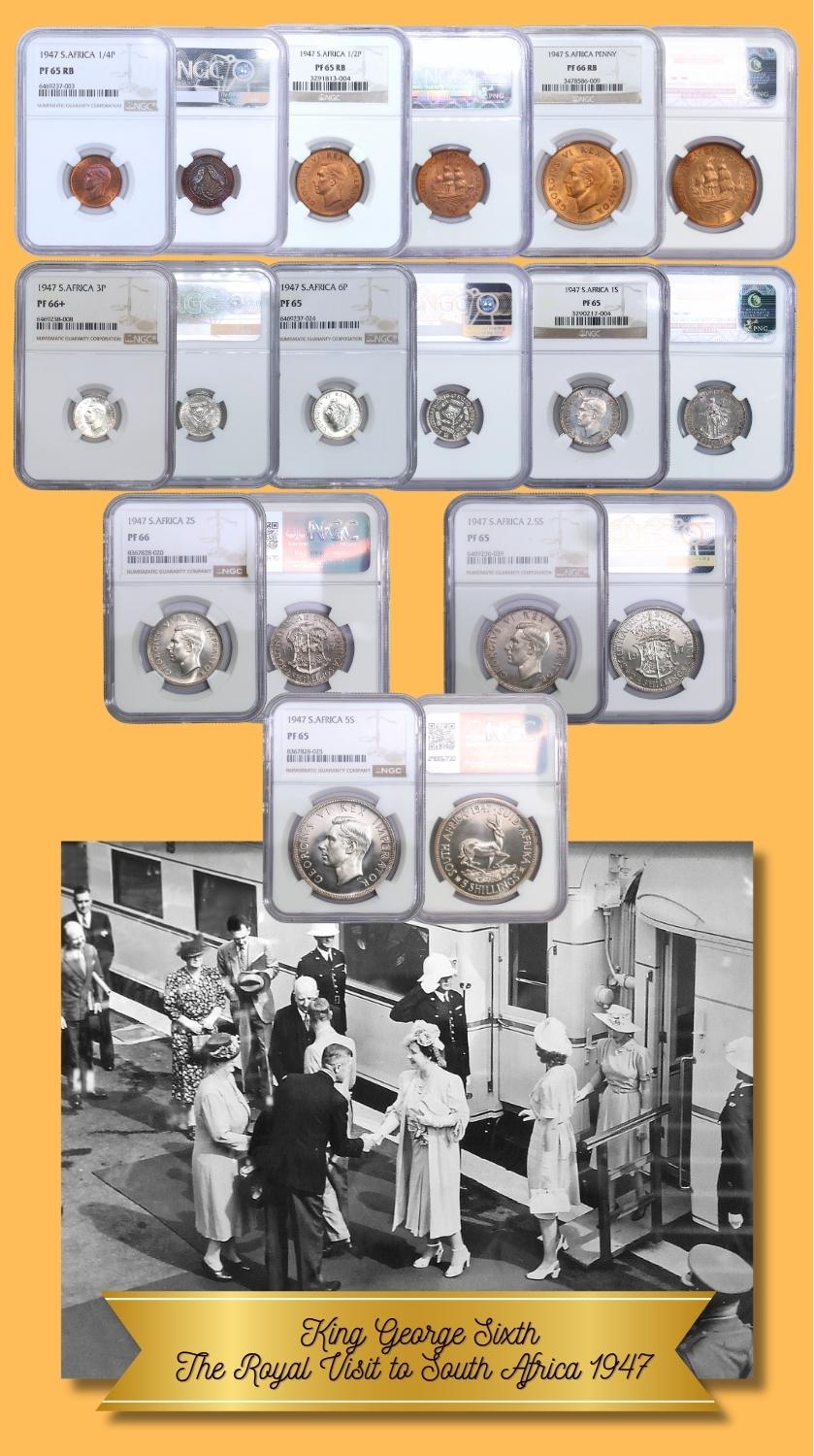
1/4d Mass: 2.83 grams Diameter: 20.2 mm Metal Content: Bronze
1/2d Mass: 5.67 grams Diameter: 25.60 mm Metal Content: Bronze
1d Mass:9.45 grams Diameter: 31 mm Metal Content: Bronze
3d Mass: 1.41 grams Diameter: 16.3 mm Metal Content: Ag 0.800
6d Mass: 2.83 grams Diameter: 19.35 mm Metal Content: Ag 0.800
1/- Mass:5.65 grams Diameter: 23.70 mm Metal Content: Ag 0.800
2/- Mass:11.31 grams Diameter: 28.70 mm Metal Content: Ag 0.800
2/6 Mass:14.13 grams Diameter: 32.30 mm Metal Content: Ag 0.800
5/- Mass:14.13 grams Diameter: 38.80 mm Metal Content: Ag 0.800
------------------------------------------------
HISTORICAL EVENTS AT THE TIME THESE COINS WERE IN USE
Due to a demand for entertainment, Johannesburg's early theatres - the Theatre Royal (1887) and the Globe Theatre - were housed in corrugated iron shacks. It was felt that there was a need for a more permanent theatre. The Standard Theatre was commissioned by Emmanuel Mendelssohn (husband of soprano Madame Mendelssohn) and financier Robert Stuart Scott, who were the managers of the Standard Building Company and joint owners of the Standard and Diggers News.
A new gallery was added in 1911 and the theatre was unused during WW1.
JA MOFFAT made alterations to the theatre in 1902, 1904, 1906, 1911 and 1912.
1911 also saw the introduction of films which gradually decreased the demand for operas.
After a fire broke out in 1947 the interior structure became unsafe. There were calls for the building to be declared a national monument but it was considered a fire hazard and it was closed in the same year. Its proposed demolition led to a public demonstration.
The site is now marked by the Oppenheimer fountain in Ernest Oppenheimer Park.
source: Artefacts: (Summarised from: Lucia, C. 2009. The World of South African Music: A Reader. Cambridge Scholars Publishing. p 127-128.)
King George VI in his capacity as King-Emperor of South Africa within the British Commonwealth visits the country with his family, for a royal tour, the first British monarch to do so in South African history.
King George VI visited South Africa in 1947 to celebrate the end of World War II and to strengthen the relationship between the British and South African governments. The visit was a significant event as it was the first British monarch to visit South Africa, and it aimed to boost the relationship with South Africa after the war.
------------------------------------------------
TO RESERVE
Call Marketing Now (011) 789-2233 or (011) 789 -2234 Or email us by clicking on This email address is being protected from spambots. You need JavaScript enabled to view it.
This offer expires on the9th OCTOBER 2026- and/or subject to availability.
E & OE - Subject to our terms and conditions.
NB: Payment option we accept for this promotion is:
Bank transfer only (EFT).
We are POPIA Compliant
------------------------------------------------
|